Regency Plum Cake

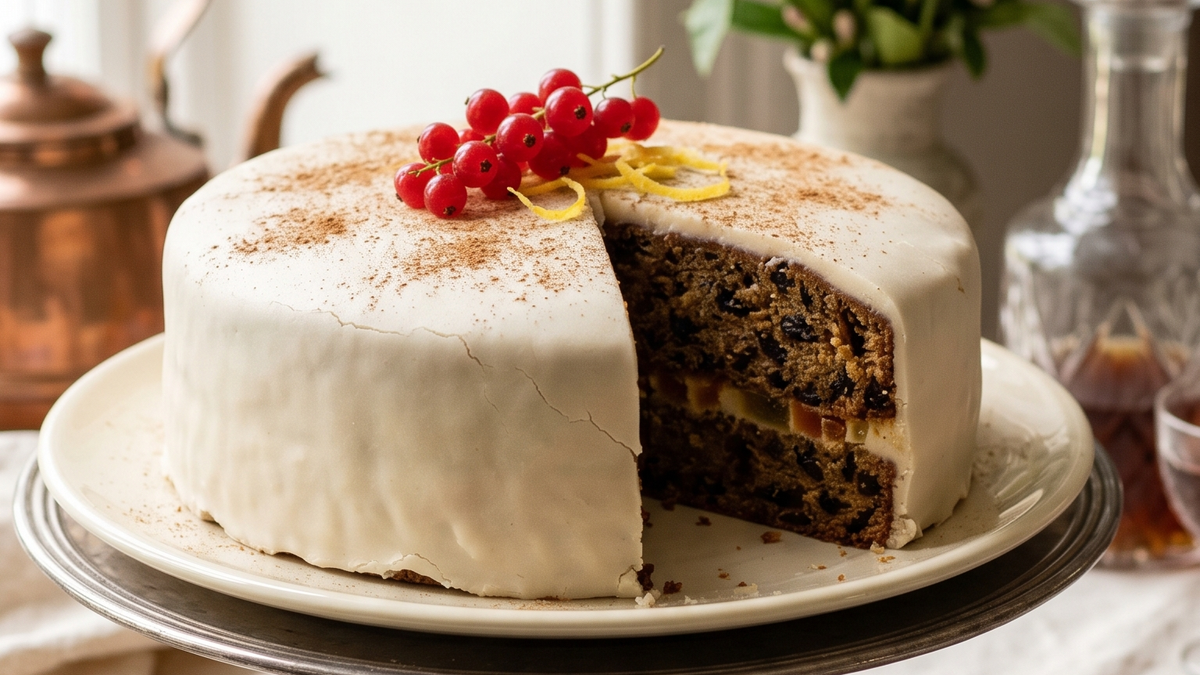
This rich and complex celebration cake is incredibly moist and buttery thanks to plenty of cream and eggs. Instead of heavy spices, it gets its delicate flavour from ground almonds, a splash of brandy, and a hint of orange flower water. The fun part is the assembly. Rather than mixing the candied citrus right into the dough, you layer it directly into the pan to create bright little pockets of fruit in every slice. To finish it off, it's topped with a simple icing that bakes into a crisp, sweet shell.
I'm working on a Regency recipe book, so I would be thrilled if you would help me by testing this and letting me know whether it works for you.
Original Recipe
Mix thoroughly a quarter of a peck of fine flour, well dried, with a pound of dry and sifted loaf sugar; three pounds of currants, washed and very dry; half a pound of raisins, stoned and chopped; a quarter of an ounce of mace and cloves; twenty Jamaica peppers; a grated nutmeg; the peel of a lemon, cut as fine as possible; and half a pound of almonds, blanched and beaten with orange flower water. Melt two pounds of butter in a pint and a quarter of cream, but not hot; put to it a pint of sweet wine, a glass of brandy, the whites and yolks of twelve eggs beaten apart, and half a pint of good yeast. Strain this liquid by degrees into the dry ingredients, beating them together a full hour, then butter the hoop, or pan, and bake it. As you put the batter into the hoop or pan, throw in plenty of citron, lemon and orange candy. If you ice the cake, take half a pound of double-refined sugar sifted and put a little with the white of an egg; beat it well, and by degrees pour in the remainder. It must be whisked near an hour, with the addition of a little orange flower water, but mind not to put much. When the cake is done, pour the icing over, and return it to the oven for fifteen minutes; but if the oven be warm, keep it near the mouth and the door open lest the colour be spoiled.
Recipe taken from: “A new system of domestic cookery, formed upon principles of economy and adapted to the use of private families” by Maria Eliza Ketelby Rundell, 1806 edition.
Modern ingredients for the cake
- 3 ⅓ cups (400g) all-purpose flour (UK: plain flour)
- ½ cup (115g) granulated sugar (UK: caster sugar)
- 2 ½ cups (340g) dried currants (or golden raisins/sultanas)
- ⅓ cup (55g) seedless raisins, roughly chopped
- ½ tsp ground cinnamon
- ¼ tsp ground cloves
- ¼ tsp ground allspice
- ½ tsp ground nutmeg
- Zest of ½ lemon, finely grated
- ½ cup (55g) almond flour (UK: ground almonds)
- 1 cup or 2 sticks (225g) unsalted butter
- ⅔ cup (150ml) heavy cream (UK: double cream)
- ½ cup (120ml) sweet sherry (or apple juice)
- 1 tbsp (15ml) brandy (or orange juice)
- 3 large eggs, separated
- 1 envelope or 2 ¼ tsp (7g sachet) instant yeast (UK: fast-action dried yeast)
- ½ cup (100g) mixed candied peel (or finely chopped dried apricots)
- 1 tsp vanilla extract
Modern ingredients for the icing
- 1 ½ cups (175g) powdered sugar (UK: icing sugar), sifted
- 1 large egg white
- ½ tsp fresh lemon juice
Modern Method
Prepare the liquids: Gently warm the cream in a saucepan and melt the butter into it. Let this mixture cool until it is merely lukewarm (about 100°F/38°C). This temperature is crucial. If it is hot to the touch, it will kill the yeast later. Once lukewarm, stir in the sherry (or apple juice) and brandy (or orange juice).
Mix the dry ingredients and fruit: In a large bowl, whisk together the flour, sugar, the fast-action yeast, and ground spices. Add the currants, chopped raisins, lemon zest, almond flour, and the vanilla extract. Toss everything together so the fruit is coated in flour, which stops it from sinking to the bottom of the cake during baking.
Whip the eggs: Beat the 3 egg yolks lightly with a fork. In a separate, clean bowl, whisk the 3 egg whites until they form stiff peaks.
Combine and beat: Pour the lukewarm cream and butter mixture, along with the beaten egg yolks, into your dry ingredients. Using a stand mixer with the paddle attachment, beat on medium speed for 5 to 8 minutes until you have a heavy, elastic batter. Gently fold in the stiff egg whites with a spatula so you don't deflate them.
Layer and prove: Grease and line an 8-inch or 9-inch (20-23 cm) round cake pan. Pour a third of the batter into the pan, then scatter half of the candied peel (or chopped apricots) over it. Add another third of the batter, the rest of the peel, and finish with the remaining batter on top. Cover with a damp towel and leave in a warm spot for 1 ½ to 2 hours to prove. It will puff up slightly, though the heavy fruit prevents a massive rise.
Bake: Preheat your oven to 325°F (160°C / 140°C fan). Bake the cake in the centre of the oven for 1 ½ to 2 hours. It is done when a skewer inserted into the centre comes out clean. Let the cake cool completely in the pan before turning it out.
Create the icing: Whisk the remaining egg white until frothy. Gradually beat in the powdered/icing sugar and the lemon juice until it forms a thick, smooth paste. Spread this over the top of the cooled cake.
Set the icing: Return the iced cake to a very low oven, about 200°F (100°C), for 15 minutes. Keep the oven door slightly ajar to dry and set the icing into a crisp shell without browning it.