Regency English Bread

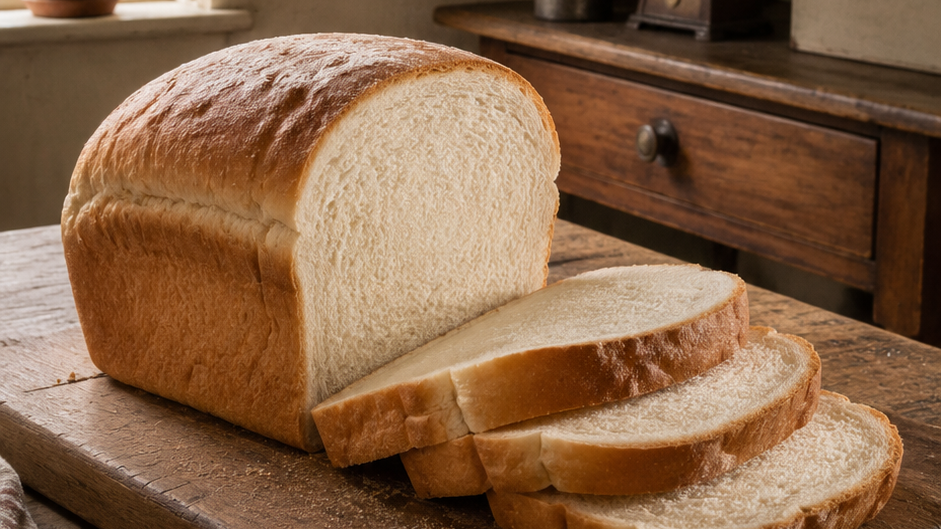
This crusty, classic white loaf features a soft, chewy interior and a sturdy crust. Simple, straightforward, and deeply comforting, this versatile daily bread is perfect for sandwiches, toast, or serving warm with a thick layer of butter.
It was surprisingly difficult to find an early Regency-era bread recipe, as it was common for households to buy bread fresh from the bakery every day. This recipe is also typical of the period, as it produces a far larger quantity than we are used to today.
Original recipe
Take a peck of the best white flour, sift it into a trough, make a cavity in the centre and strain through a hair sieve (mixed together) a pint of good yeast and a pint of lukewarm water. Mix them lightly with some of the flour till of a light paste. Set it in a warm place covered over to prove for an hour, then mix the whole with two quarts of lukewarm water and a little salt. Knead it; let it be of a good stiffness. Prove it an hour more and knead it again. Prove it another hour. Mould it into loaves or batch two pieces together and bake them in a brisk oven.
N.B. A middling-size loaf will require an hour and a half in baking.
Recipe taken from “The Art of Cookery Made Easy and Refined, Comprising Ample Directions” by John Mollard, 1802.
Mollard does not favour us with his definition of a peck. As a measure of volume, it often represents a quarter of a bushel, which can be defined as around 8 to 10 pounds. However, in some recipes it is taken to mean 12 or 14 pounds.
Modern ingredients
4 cups (500g) bread flour (UK: strong white bread flour)
2 ¼ tsp (7g) fast-action instant yeast
1 ½ tsp (8g) fine sea salt
1 ½ cups (350ml) lukewarm water
1 tbsp (15g) butter or neutral oil, for greasing
Modern method
Mix the dry ingredients: In a large mixing bowl, whisk together the flour, fast-action instant yeast, and fine salt.
Form the dough: Make a well in the center of the dry ingredients and pour in the lukewarm water. Stir the mixture together until a rough, shaggy dough forms.
Knead the dough: Turn the dough out onto a lightly floured surface and knead for 8 to 10 minutes, or use a stand mixer fitted with a dough hook on medium-low speed, until the dough becomes smooth and elastic.
First rise: Place the dough in a lightly greased bowl, cover loosely with a damp cloth or plastic wrap, and leave it in a warm place for 1 hour, or until doubled in size.
Shape the loaf: Punch the dough down gently to release the trapped air, then shape it into a tight, neat log and place it into a greased 9x5-inch (2lb) loaf pan.
Second rise: Cover the pan loosely and let the dough rise for another 45 to 60 minutes, or until the dough crests just above the rim of the pan.
Preheat the oven: While the loaf is finishing its final rise, set your oven to 400°F (200°C/180°C fan).
Bake the bread: Bake the loaf for 35–40 minutes, or until the crust is a deep golden brown and the bottom of the bread sounds hollow when gently tapped.
Cool completely: Turn the bread out of the pan immediately and transfer it to a wire rack, allowing it to cool entirely before slicing.